Why Google Ads Doesn’t Show Every Clicked Query
What the Search Terms Report is and why it matters
When you run search ads in Google Ads, you pick keywords — the queries you expect people to type when they need what you offer. Say you’re an attorney targeting car accident cases. You build out your keyword list: “car accident attorney,” “car accident attorney helpline,” “settlement after car accident.” Five keywords, ten, a hundred. You convince yourself you’ve covered every possible angle.
Real users don’t work that way. They type longer, shorter, sideways. They dictate full sentences into voice search. So Google matches actual queries to your keywords by semantic intent. The same keyword “car accident attorney” can trigger your ad when someone searches “how do i know if i need a personal injury attorney after a minor car accident,” or “what to do when the other driver is lying about the car accident,” or even “fake accident attorney website” — if you haven’t set up negative keywords properly.
The Search Terms Report is where you see exactly what people typed before clicking your ad. Real query, matched keyword, impressions, clicks, CTR, cost, conversions. It’s the only window into the actual semantic behavior of your audience. Studying it is useful. Systematically pulling large volumes of these queries and running them through a decent AI for clustering — understanding which speech patterns dominate — is even more useful.
But there’s something else in this report that most people gloss over, and it’s genuinely important. Scroll to the bottom, to the summary rows. You’ll see how many search queries made it into the report — and how many didn’t. That second number will occasionally make you question things.
How much data Google actually hides
Let’s talk numbers. In 2025, Taikun Digital analyzed data from 933 Google Ads search and shopping campaigns with a combined budget of nearly $20 million and 14 million clicks. The study found that on average, advertisers can’t see the search queries responsible for 26.7% of Search spend and 33.5% of Shopping spend. The hidden queries performed significantly worse: average ROAS on visible queries was 2.2x higher (5.60 vs. 2.59), CTR was 77.5% higher, and CPC was 52% lower. The authors frame this not as isolated anomalies but as a systemic transparency loss across a meaningful share of search budget.
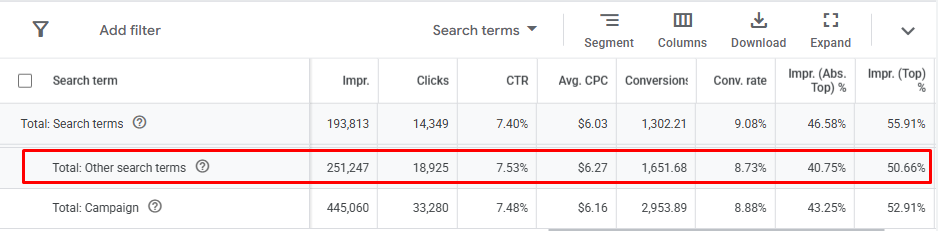
Below you’ll find a screenshot from one of our client accounts over an arbitrary period (shared with permission, company name withheld). The red box shows the hidden traffic segment — Other Search Terms. We don’t know what those queries are. But we can clearly see they account for roughly 56% of all impressions and clicks. CTR in that hidden segment is actually slightly higher, even though ads were serving in lower positions than in the visible Search Terms group. That’s a flag. If ad position is lower, CTR should be lower too — that’s not what we’re seeing here. You can’t prove fraud, but you can definitely raise an eyebrow. Google’s reps would say it’s simply better ad-to-query matching in that group, all in service of hitting performance targets.
Speaking of Google reps — Ginny Marvin addressed the questions raised by the Taikun Digital study directly. Her position: hidden search terms are a privacy requirement, not a transparency limitation. Google’s line is that even if individual queries don’t appear in Search Terms reports, they still feed the optimization algorithms and count toward relevant traffic targeting and campaign goal achievement.
Let’s walk through each reason search queries get hidden — both the official explanations and what actually makes sense when you think it through.
Reason one: the privacy threshold — Google’s official position
Google attributes the missing queries to something called the privacy threshold. The rule works like this: a query won’t appear in your Search Terms report if its total search volume across the entire Google platform is too low. The logic is that rare, one-off queries could potentially be used to indirectly identify individual users or very small groups of people.
In practice, this targets the long tail — single-occurrence or rarely repeated formulations that might appear only a handful of times per day across the entire platform. Think hyper-specific commercial queries like “industrial HVAC repair emergency Miami Sunday night,” narrow B2B combinations like “SAP integration consultant for healthcare mid-size company pricing,” local queries with precise routing or timing details, and rare branded misspellings or phrasing variants.
These queries aren’t necessarily sensitive in terms of content. The determining factor is frequency, not subject matter: if a query is rare enough at Google scale, it doesn’t clear the threshold and doesn’t surface in Search Terms. It either gets aggregated into “other search terms” or disappears from reporting entirely — even if it participated in the auction and generated clicks.
Reason two: personally identifiable information
Unlike the privacy threshold — which is based on low query frequency — this one is about the content of the query itself. Google withholds queries that contain personally identifiable information (PII) from advertisers.
This covers formulations that could directly or indirectly identify a person or their location. A query like “limo from 47 Lilac Lane Brooklyn to JFK” would qualify, as would anything containing names, phone numbers, precise addresses, medical details, or other sensitive specifics.
Here, volume is irrelevant. Even a single query can be excluded entirely. The reason is regulatory: GDPR in Europe and CCPA in the US restrict or prohibit passing personal data to third parties, including advertisers. In this context, Google isn’t acting as an ad platform — it’s acting as a regulated data processor legally required to strip that information from reports.
Reason three: queries flagged as invalid traffic
This layer of filtering almost never comes up in Google’s official explanations, but it surfaces regularly in conversations among click fraud detection specialists and performance marketers. The mechanism here is invalid traffic (IVT) filtering, which Google runs automatically at the auction and billing level.
Google and the industry standard set by the Media Rating Council (MRC) divide invalid traffic into two classes: GIVT (General Invalid Traffic) and SIVT (Sophisticated Invalid Traffic). GIVT covers known bad actors — bots, crawlers, signature patterns — that can be identified and filtered automatically at an early stage. SIVT is harder: it mimics real user behavior and requires multi-layered analysis, sometimes with post-hoc verification.
SIVT is considered the most difficult segment of modern ad fraud precisely because it lacks obvious signatures and can partially pass through automated filters before being classified as invalid.
Against this backdrop, the industry occasionally floats the hypothesis that some portion of anomalous or invalid traffic ends up outside standard reporting — including in the hidden or aggregated search query segments. This interpretation remains speculative and has not been confirmed by official Google statements or independent auditors.
Reason four: computational and infrastructure constraints
Beyond privacy and filtering thresholds, there’s a less-discussed but logically obvious factor: the scale of computational load. Google processes billions of search queries every day. Generating granular reporting at the individual advertiser account level requires substantial resources for storage, aggregation, and processing.
In this context, the frequency threshold serves not just a privacy function but a technical one. It eliminates the need to store and surface a massive volume of rarely repeated queries that, from Google’s perspective, have minimal impact on the overall picture of campaign performance — but would significantly inflate data volumes.
Put plainly, limiting report granularity can be read as a way of balancing analytical value against the cost of processing it at the scale of a global ad system. This isn’t an officially stated reason — but it follows logically from the architecture of any high-load system like this.
Reason five: monetizing low-quality inventory
This is where things get interesting, and where industry consensus diverges from Google’s official position.
Colin Slattery, the author of the Taikun Digital study referenced above, states his conclusion without hedging:
“For every $1 in ads you buy, Google siphons $0.85 in forced inefficiency through hidden search terms.”
He goes further:
“I’m firmly in the “this is not for privacy but for Google to sell low quality inventory” camp, and the rest of the data bears that out.”
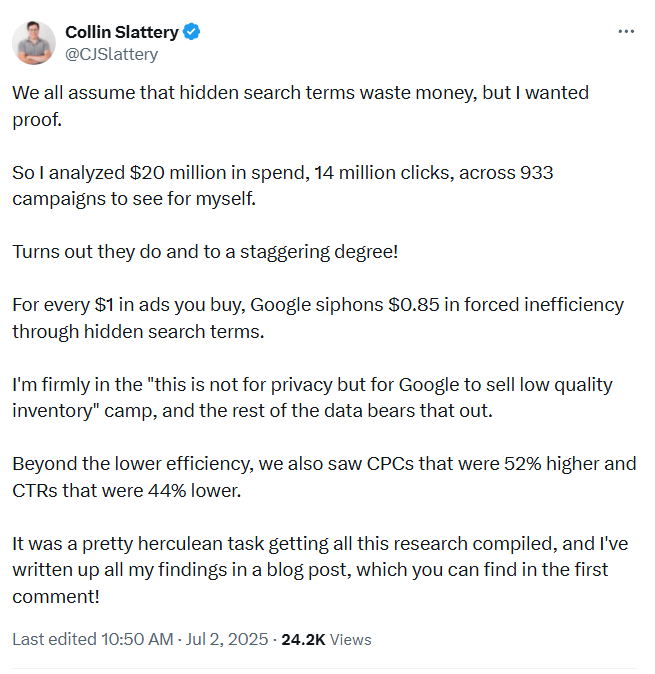
In other words, his read is that hidden search queries represent not just a transparency problem but a structural inefficiency baked into the auction — one that systematically benefits Google at the advertiser’s expense.
Worth being clear: this is the author’s interpretation based on his dataset, not an established industry fact. But it rests on a substantial sample ($20M in spend, 14M clicks, 933 campaigns) showing persistent performance gaps: higher CPC and lower CTR in the hidden query segment versus the visible one.
From our perspective, this isn’t an accusation — it’s a signal from the professional community that can’t be ignored. And until Google gives advertisers the ability to at least block hidden traffic entirely, this conversation isn’t going anywhere.
Reason six: strategic opacity in favor of automation
There’s one more systemic factor that rarely gets named directly, but tracks clearly with how the Google Ads platform has evolved. Over the past several years, Google has consistently pushed automation — Smart Bidding, Performance Max, automatic keyword expansion.
As automation increases, the granularity available to advertisers at the individual query level decreases. The management model shifts: instead of analyzing specific search terms, advertisers increasingly work with aggregated signals and algorithmic recommendations.
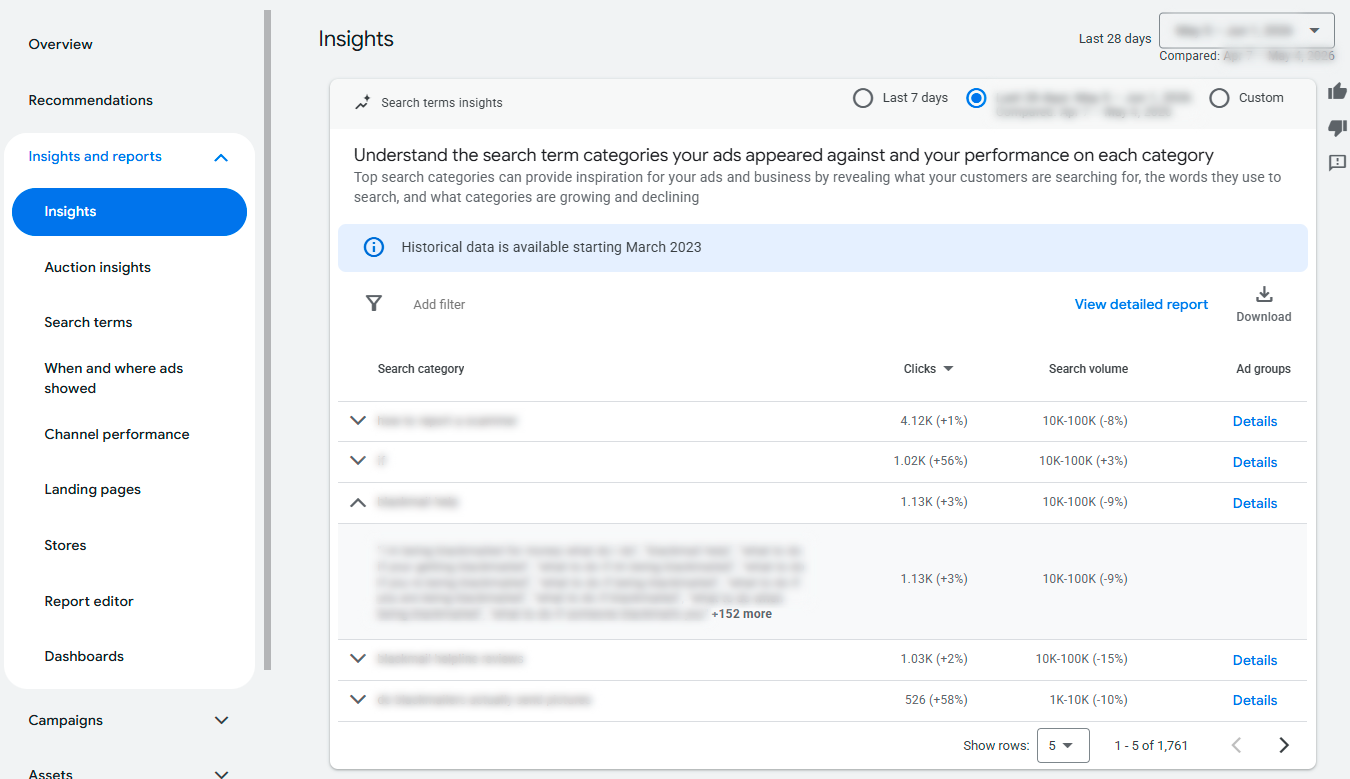
Google partially compensates for this through tools like Search Terms Insights in the Insights tab, which does show categories of search queries — including groups that don’t surface in the standard report due to privacy thresholds. But this representation is limited: instead of actual queries, you get topical clusters. Convenient? Somewhat. Sufficient for real analysis? Not even close.
What you can actually do with the data you have
Accepting partial data observability as a given isn’t defeat — it’s a functional analytical position. The goal is to extract maximum signal from the portion of the Search Terms Report that’s actually accessible.
Even within a limited dataset, stable patterns exist that can be analyzed without access to hidden queries. Long-tail low-frequency formulations with sudden impression spikes can indicate traffic probing or testing. A separate class covers queries that activate sharply for a short window — one or two days — then disappear. That’s the G2 pattern, and it’s well-suited to time series analysis. Another signal is high-frequency queries with anomalous Z-score deviations relative to a stable baseline — the G3 pattern, a statistically significant outlier.
These three behavioral anomaly types are exactly what ClickFraudLab is built around. Upload your Search Terms Report export for any period, and the tool automatically surfaces patterns characteristic of potential click fraud — without manually combing through thousands of rows.
Bottom line
Google doesn’t show you every search query in Search Terms reports. The official explanation centers on user privacy, but the full picture involves multiple layers simultaneously: statistical thresholds, legal requirements, invalid traffic filtering mechanics, infrastructure decisions, and a strategic shift toward automated campaign management.
For advertisers, this means one thing: the visible data isn’t the complete picture of user behavior — but it’s still a valuable source of signals, as long as you treat it as a partial projection rather than a full cross-section of the system.
Even in limited reports, stable behavioral patterns remain available for analysis and interpretation. The question is how precisely you’ve defined the criteria for extracting and classifying those signals.
Frequently Asked Questions
What is the Search Terms Report in Google Ads?
The Search Terms Report shows the actual queries people typed before clicking your ad. Unlike your keyword list, which reflects what you think users search for, this report captures real user language — including long-tail variations, voice search phrases, and semantically matched queries Google triggered your ad on. It includes impressions, clicks, CTR, cost, and conversions per query, making it the primary source of real audience behavior data in Google Ads.
Why doesn’t Google show all search terms in the report?
Google withholds search queries from the Search Terms Report for several reasons that stack on top of each other. The main official reason is the privacy threshold: queries that occur too infrequently across the entire Google platform are excluded to prevent indirect identification of individual users. Separately, queries containing personally identifiable information (names, addresses, phone numbers) are always excluded regardless of volume, due to GDPR and CCPA requirements. Beyond the official explanations, researchers have also pointed to invalid traffic filtering, infrastructure constraints, and the platform’s strategic shift toward automation as contributing factors.
How much of my Google Ads budget is spent on hidden search terms?
According to a 2025 Taikun Digital study analyzing 933 campaigns with nearly $20 million in combined spend, advertisers on average cannot see the queries responsible for 26.7% of Search budget and 33.5% of Shopping budget. Performance in the hidden segment was significantly worse: visible queries showed 2.2x higher ROAS, 77.5% higher CTR, and 52% lower CPC compared to the hidden segment.
What are “Other Search Terms” in Google Ads?
“Other Search Terms” is the aggregate category in the Search Terms Report footer that groups all queries Google chose not to individually disclose. It shows total impressions, clicks, and cost for the hidden segment without revealing the actual queries. The gap between your visible Search Terms metrics and your total campaign metrics reflects this hidden traffic. In some accounts, this segment can account for more than half of all impressions and clicks.
Is Google hiding search terms to protect user privacy or to make more money?
Google’s official position attributes hidden search terms entirely to user privacy requirements, specifically the privacy threshold mechanism and PII filtering. However, Colin Slattery of Taikun Digital, after analyzing $20M in ad spend across 933 campaigns, publicly concluded that the hidden segment functions as a mechanism for selling low-quality inventory rather than a genuine privacy measure, noting that hidden queries consistently underperform visible ones on every key metric. Both interpretations exist in the industry. The data showing performance gaps is real; the cause behind Google’s policy decisions is disputed.
What is a privacy threshold in Google Ads?
The privacy threshold is Google’s rule for excluding rare search queries from advertiser-facing reports. If a query occurs too infrequently across the entire Google platform, it doesn’t surface in the Search Terms Report — even if it triggered your ad and generated clicks. Google’s stated purpose is to prevent advertisers from using rare query data to indirectly identify individual users. The threshold is applied at the platform level, not the account level, so a query can be hidden from your report even if it appeared multiple times in your own campaigns.
Can I block hidden search term traffic in Google Ads?
Currently, no. Google does not provide a mechanism to directly block or exclude the “Other Search Terms” traffic segment. You can reduce exposure to low-quality queries through negative keyword lists, tighter match type settings, and audience targeting layering — but none of these give you direct control over the hidden segment specifically. This limitation is a recurring point of criticism among performance marketers and click fraud researchers.
How do I detect click fraud in my Search Terms Report?
Even without access to hidden queries, the visible portion of the Search Terms Report contains detectable anomaly patterns. Three behavioral signals are worth watching: long-tail queries with unusually high impression spikes relative to their word count and typical frequency (G1 pattern); queries that activate sharply for one to three days and then go silent (G2 pattern, consistent with traffic probing); and high-frequency queries where a single day’s impressions deviate significantly from the weekly baseline by Z-score greater than 2.0 (G3 pattern). Tools like ClickFraudLab automate detection of all three patterns from a standard Search Terms Report export.
What is Performance Max and how does it affect search term visibility?
Performance Max is Google’s fully automated campaign type that serves ads across all Google channels simultaneously — Search, Display, YouTube, Gmail, Maps, and Discover. In Performance Max campaigns, search term visibility is even more limited than in standard Search campaigns. Google provides only high-level search category data rather than individual queries, making it structurally impossible to conduct the same granular analysis available in traditional Search campaigns. This reduced visibility is a known trade-off of the Performance Max format.
What can I do with the Search Terms data I can actually see?
Treat the visible portion of your Search Terms Report as a sampled projection of user behavior rather than a complete record. Focus on extracting structural patterns: identify negative keyword candidates from irrelevant matched queries, spot clusters of semantically similar queries that reveal user intent not captured in your keyword list, flag anomalous traffic patterns that suggest invalid activity, and use the data to refine match type strategy. For systematic analysis across large query volumes, exporting the report as CSV and running it through a dedicated analysis tool gives results that manual review cannot match at scale.